Life Sciences Bridge Award 2026
Jonathan received the Life Sciences Bridge Award of the Aventis Foundation (€100,000), presented at the Literaturhaus Frankfurt, for his work on selective mRNA translation as a regulatory axis of immune cells.
We study how translational control shapes immune cell function and how defects in protein synthesis cause human disease.
© Jan Greune Emmy Noether Group Leader
Molecular biologist studying mRNA translation, human genetics, and molecular immunology at the Gene Center Munich.
New preprint
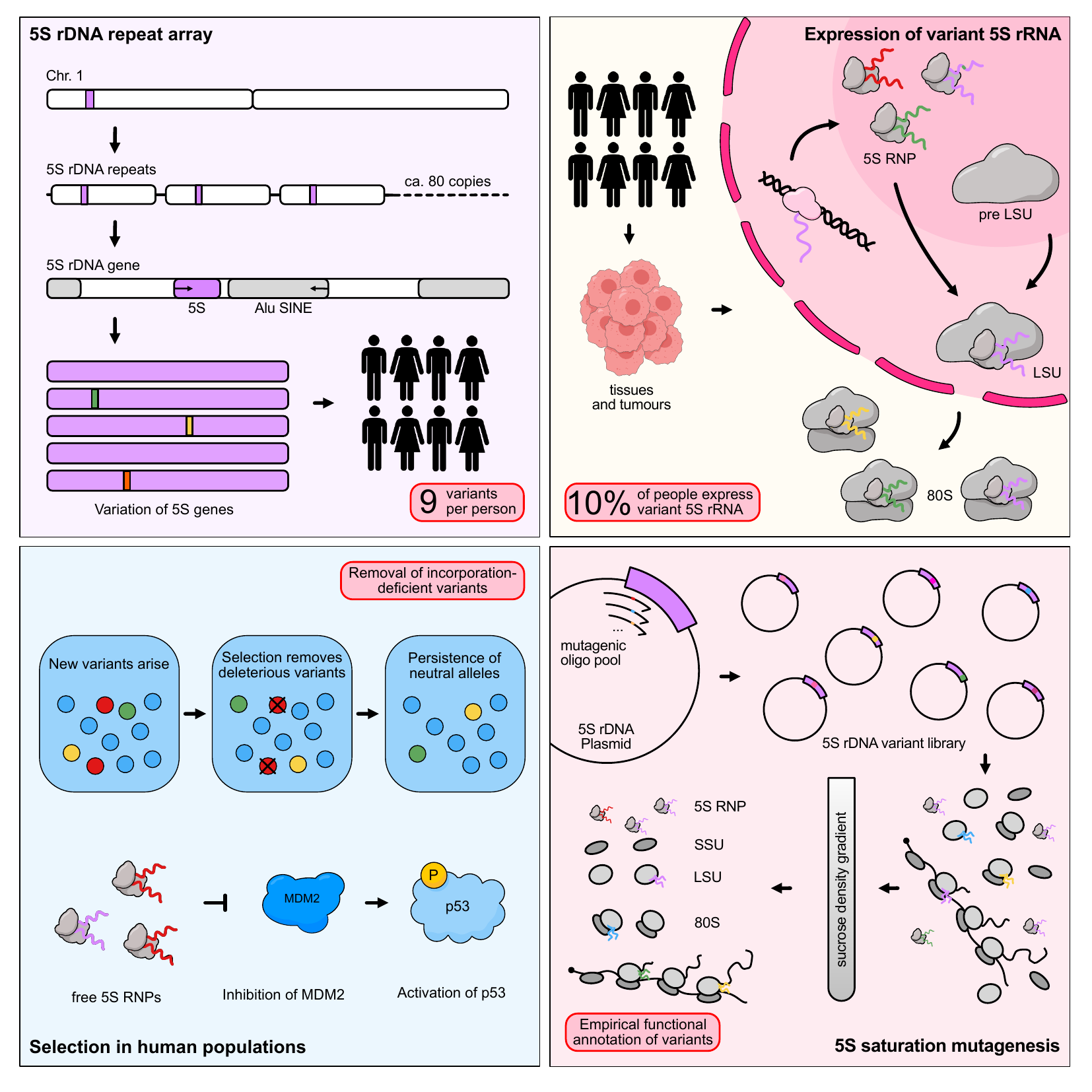
Resolves sequence variation across the human 5S rDNA array — one of the genome's least-explored regions — showing that variant 5S rRNAs are expressed and that ribosome-assembly-blocking variants are purged from human populations through p53 surveillance. Accompanied by an interactive atlas.
We combine expertise from three disciplines to create a unique research perspective.

We use cutting-edge biochemical and structural approaches to understand the molecular machinery of protein synthesis - ribosomes, tRNAs, and translation factors.

We study how immune cells - particularly T cells - regulate their proteome through translational control during activation, differentiation, and disease.

We leverage rare genetic disorders affecting the translation machinery to uncover fundamental biology and develop therapeutic strategies.

We use cutting-edge biochemical and structural approaches to understand the molecular machinery of protein synthesis - ribosomes, tRNAs, and translation factors.
We study how immune cells - particularly T cells - regulate their proteome through translational control during activation, differentiation, and disease.
We leverage rare genetic disorders affecting the translation machinery to uncover fundamental biology and develop therapeutic strategies.

Our work spans three interconnected areas of translational control in immunity.
How do T cells rewire their translational machinery during activation, differentiation, and effector function?
Understanding how monogenic ribosome defects lead to selective immunodeficiency syndromes.
Investigating the links between tRNA biogenesis, modification, and autoinflammatory disease.
Latest news from the lab, including publications, grants, prizes, and milestones.
Jonathan received the Life Sciences Bridge Award of the Aventis Foundation (€100,000), presented at the Literaturhaus Frankfurt, for his work on selective mRNA translation as a regulatory axis of immune cells.
Mythili Padavu joins the lab as a doctoral researcher after completing her master's thesis at LMU Munich. Welcome to the team!
Resolves sequence variation across the human 5S rDNA array — one of the genome's least-explored regions — showing that variant 5S rRNAs are expressed and that ribosome-assembly-blocking variants are purged from human populations through p53 surveillance. Accompanied by an interactive atlas.
Explore the interactive atlas →Demonstrates that somatic CBL deficiency selectively impairs B cell development while sparing T cell function, revealing cell-type specific requirements for this E3 ubiquitin ligase.
Expands the genetic and clinical spectrum of X-linked MCTS1 deficiency by identifying four new patients with complete or partial forms, including the first hypomorphic MCTS1 variant.
We're always looking for curious and motivated scientists to join our team at the Gene Center Munich.
See Open PositionsThe Bohlen Lab is located at the Gene Center of Ludwig-Maximilians-Universität München, one of Europe's leading research universities.
Get in touch
© Jan Greune Our research is supported by the Emmy Noether Programme of the German Research Foundation (DFG).
Latest from Bluesky
This will fetch the latest post from Bluesky's public API.
Or visit profile directly →